The Heartfullness program is conducted by our college on 6.12.2018 and 7.12.2018. The program is conducted through video conference .
Welcome! Heartfulness is a beautifully simple practice of meditation that connects us with all the light and love in our heart.

- HEARTFULNESS ENABLED SCHOOLSJoy and Trust in ClassroomsRight environment to facilitate changeDeep listening and Compassionate LeadershipCreate a loving Learning Environment.
The HEART Program
The HEART Program is a teachers training program that spans one academic year consisting of five components, which equip teachers with Heartfulness practices, life skills and knowledge for quality educational outcomes.
The Need
Teachers are devoted to making a positive change in student’s lives. A teachers’ role is demanding physically, mentally and emotionally, yet most teachers’ training focuses only on pedagogy and content, without developing social, emotional and cognitive abilities, shown to be more important as qualities for leaders in today’s world.

A Heartful Teacher
A Heartful Teacher will be a role model, one who is inspired and nurtures
inspiration in students. Here are some specific qualities
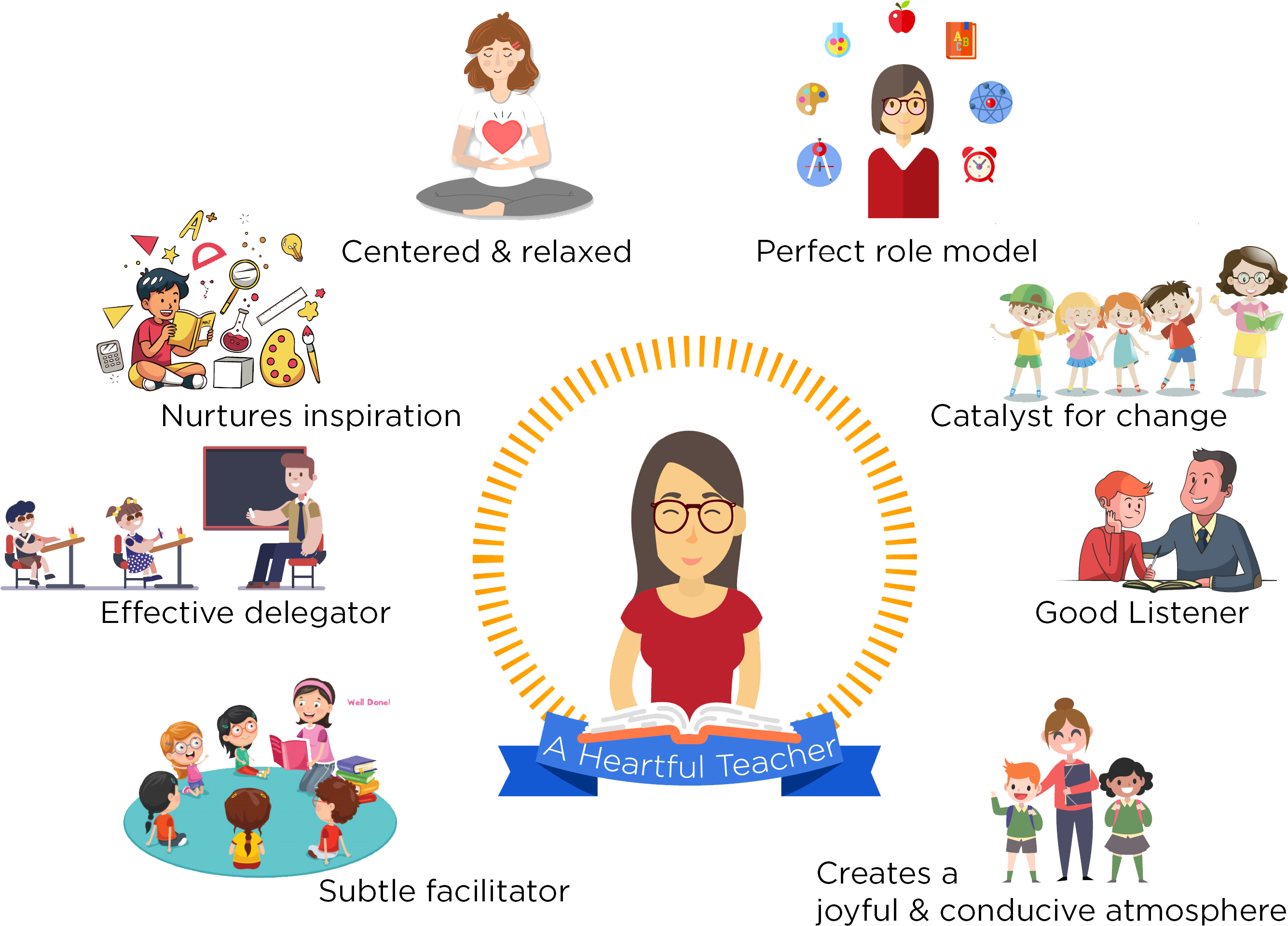

Good Communicator

Delegator

Evoking Love

Subtle and Indirect

Facilitator

Centered and Relaxed

Good Listener

Witness

Right Environment

Catalyst for Change

Power of Thoughts

Joyful Atmosphere
Manifestations: Measuring Impact in Classroom
Emotional Intelligence:Practising the Heartfulness methodology will have a positive effect on ‘Emotional Intelligence’ in teachers, e.g. self-awareness, self-regulation, social skills, empathy and motivation.
- Number of questions asked during class.
- Number of times the teacher smiles in class.
- Number of times the teacher appreciates the opinion of a student.
- Emotional perception: Number of times the teacher ‘felt’ the needs of students and responded appropriately.
Resilience: Practising the Heartfulness methodology will have a positive effect on ‘Resilience’ in teachers, where Resilience is defined as the time it takes to bounce back from adversity and challenge.
- Number of times the teacher takes a pause to respond effectively instead of immediately reacting to the situation.
- Number of times the teacher displays ‘poise and grace’ in a disruptive classroom.
- How long does it take to resolve any conflict or disruption in class?
- How long does it take the teacher to bounce back from an incident?
Attention: Practising the Heartfulness methodology will have a positive effect on ‘attention’ in teachers,
where attention is a measure of ability to concentrate and remain focused for a period of time.
- Eye contact:
- Is the teacher attentive to any student who is responding?
- Do the teacher’s eyes pan the classroom to engage attention and create rapport?
- Body language: how often is body language tense or closed versus relaxed, open and inviting?
- Number of times the teacher is distracted in class.
- Number of minutes spent listening to students during class.
Classroom Management:Practising the Heartfulness methodology will have a positive effect on ‘classroom management’ in teachers, e.g. time and space management, effective communication, conflict resolution, discipline and structure.
- Classroom Climate:
- Does the teacher involve students in creating routines in the classroom?
- Is the teacher able to delegate tasks to students?
- Do students hesitate or are they forthcoming with requests and questions?
- Is the classroom ‘lively’ and at the same time ‘orderly’?
- How do students feel in the classroom: joyful, afraid, bored?
- How many practical or experimental activities are included in class?
- Number of minutes that students are allowed to ‘present’ in class.
- Peer learning: number of times students learn from other students.
- Orderly and creative arrangement of items and displays of work in the classroom.
INSPIRE
Overview:
INSPIRE is a 3-day experiential workshop for teachers, with sessions on:
- Heartfulness practices and techniques essential for self-management,
- Heartfulness heart-centered learning pedagogy,
- Inquiry-based learning, and
- Essential life skills
that enable teachers to create joyful activity-based learning in classrooms.
The workshop also orients teachers to the second component of the module, INTEGRATE. One champion teacher will be selected from every school, to will be trained through the INCLUDE program to take forward the weekly group sessions in the school, among other things.
Objectives:
- To learn the four basic Heartfulness practices of:
a) Relaxation,
b) Meditation,
c) Mental Cleaning, and
d) Inner Connect. - To become adept at conducting guided Relaxation for all their students, and able to give instructions for Heartfulness meditation to students 16 years and over.
- To be introduced to heart-centered pedagogy for the 21 st century, understand the various methodologies, and go through initial practical training to apply the same in their classroom.
Outcomes:
- Teachers learn basic Heartfulness practices to manage their own stress and emotions, and improve their quality of life;
- As a result, teachers will be more relaxed and centered, and will connect more easily with their students in classrooms.
- Teachers are enabled to teach Heartfulness Relaxation to students;
- Teachers are enabled to give instructions for Heartfulness Meditation to students 16 years and over;
- Teachers learn some basic tips on how to bring to heart-centered pedagogy for the 21 st century into their classrooms, e.g. inquiry-based learning, interactive learning, and facilitated learning.

INVOLVE
Overview:
The INVOLVE program happens after 6 months of engagement with the teachers. This component is a 3-day intensive workshop, the level 2 version of INSPIRE, that helps deepen the understanding of the Heartfulness Way. In addition to diving yet deeper still into Heartfulness, it covers practical sessions in handling real-life classroom situations and learning how to be a heartful presenter and facilitator. This workshop will also reinforce and discuss learnings from the last 6 months of teacher engagement, solutions and actions for challenges experienced in school etc.
Objectives:
- To learn to use meditation to bring about change in all aspects of daily life, both personal and in the classroom;
- To provide a platform to solve real-life classroom issues using the various heart-based methods taught in this workshop; and
- To become confident heartful presenters and facilitators, with enhanced communication and soft skills.
Outcomes:
Teachers will:
- Start to become adept meditators;
- Feel an active sense of contribution and innovation in their role as an educator;
- Naturally feel a sense of purposeful duty and responsibility for their class, their school and in their community;
- Be able to solve the challenges of the classroom environment with more confidence, and
- Exhibit enhanced communication and soft skills in the classroom environment.
Conclusion
Heartfulness cleaning and meditation had a positive effect on sympathovagal balance.

 Janani singer